Holiday planning
How to Organize Your Christmas Gift List and Actually Stick to a Budget

What breaks a Christmas budget is usually the forty small things nobody wrote down: the teacher's gift card, the third roll of wrapping paper, the stocking stuffers grabbed at the checkout, the "we should get something for the neighbors" on December 22. A Christmas gift list fixes that, but only if it's built in the right order. Most people start with gift ideas. Start with the money instead, then the people, then the ideas.
Start with one number
Before you write a single name, decide what the whole season costs. One number, total, including gifts and everything around them.
If you don't know what you can afford, start from what's left after December's fixed bills and work down from there. Our free family budget planner is a quick way to see that number if you've never worked it out. If December throws off the rest of your year, a family budget with a sinking fund for Christmas is the longer-term fix.
For a reality check, the National Retail Federation's survey for last year's holidays found Americans planned to spend about $890 per person on the holidays, $628 of it on gifts. That's an average across everyone, so don't treat it as a target. But if your plan is $2,000 and your December paycheck says $900, you'll know the list has to change before you buy anything.
Then hold back 10 to 15 percent of the total for the things that never make it onto a gift list, like wrapping paper and stocking stuffers.
Build your Christmas gift list from the people out
Now write down everyone you might buy for. Everyone. It's easier to cross names off a complete list than to remember people at the last minute.
Then sort them into tiers. Splitting the total evenly makes no sense (your kid and your coworker aren't the same line item), and tiers are faster than agonizing over 20 separate amounts.
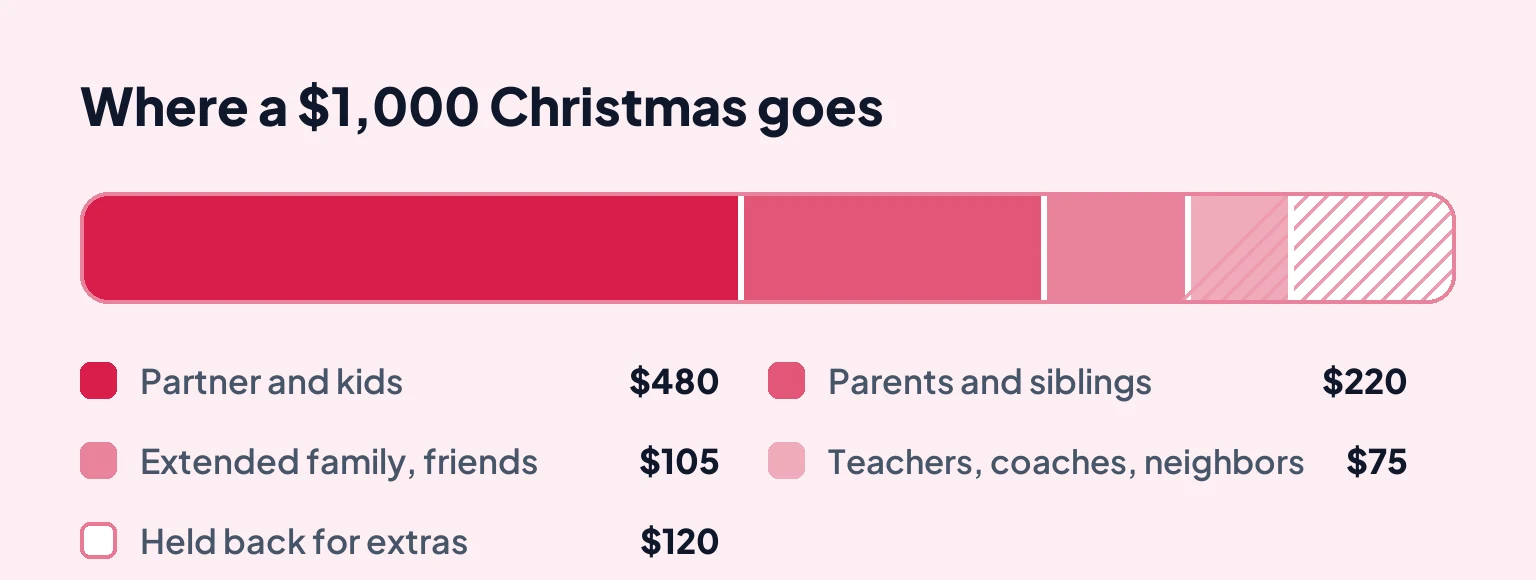
Say your total is $1,000 and you've held back $120 for extras. That leaves $880 for gifts:
| Tier | Who | Share of gift money | Example |
|---|---|---|---|
| 1 | Partner and kids | about 55% | $480, split across 3 people |
| 2 | Parents and siblings | about 25% | $220, or $40–$50 each |
| 3 | Extended family, close friends | about 12% | $105, or $15 each for 7 people |
| 4 | Teachers, coaches, hosts, neighbors | about 8% | $75, or $10–$15 each |
Your percentages will be different. The point is that every person on the list gets a number before you start browsing. When you find the perfect $90 jacket for someone in tier 2, you can see right away what it costs you elsewhere.
Cut the list before you cut the gifts
If the tiers don't fit, the honest fix is usually fewer people on the list. Cheaper presents for everyone just spreads the disappointment around.
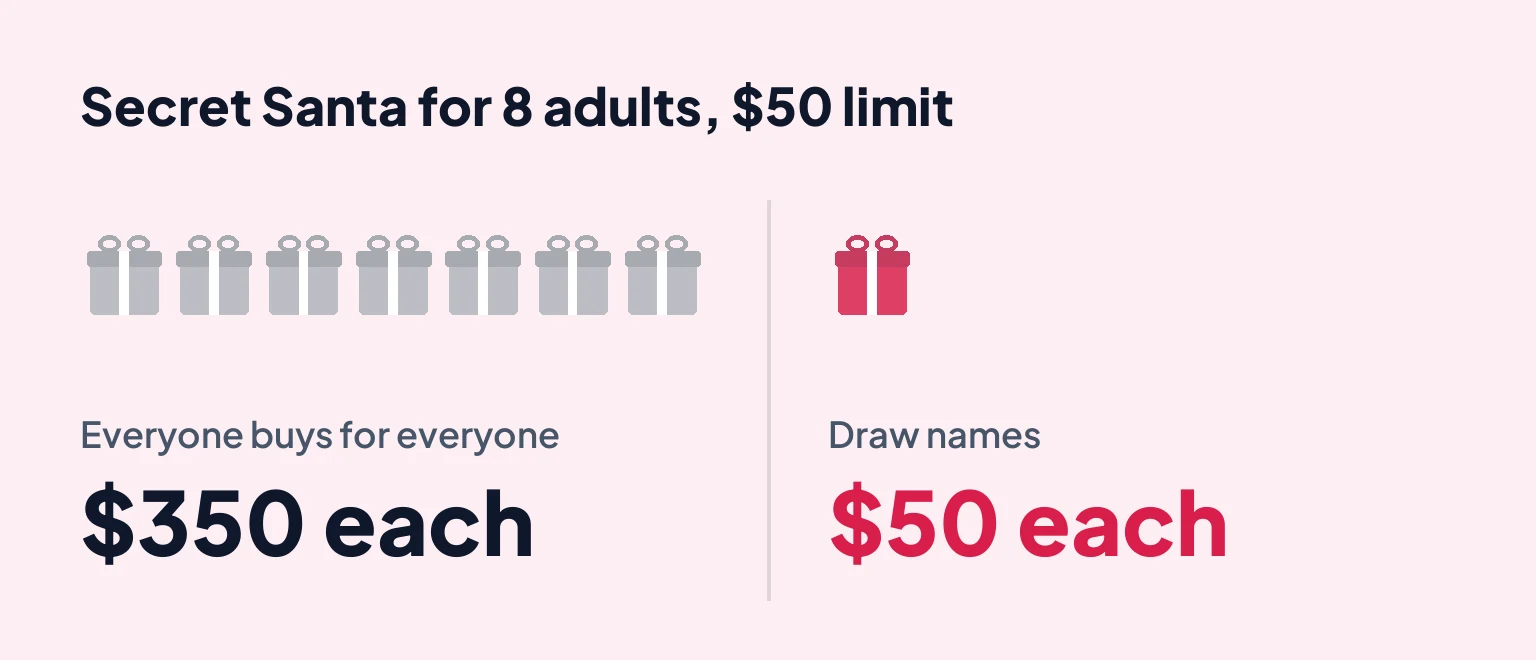
The simplest version is a name draw. Adult siblings and cousins each buy for one person, with a set limit, so in a Secret Santa for 8 adults at $50, everyone spends $50 where they'd otherwise have spent $350.
A few other ways families do it:
- Give one gift per household, like a board game or a nice food basket for your sister's family instead of four separate presents.
- Agree that the adults stop exchanging and only the kids get presents.
- Swap two December gifts for something you'd do anyway, like taking your parents out to dinner in January.
Someone has to suggest it first. Do it in early November, before anyone has shopped.
Turn ideas into a list you can track
A list of names and budgets isn't enough. The part that goes wrong in December is tracking: who's covered, and which gifts are still sitting in a box in the trunk.
Give every gift a row with these columns:
- Person and their budget
- Gift (or idea, until you decide)
- Price you actually paid
- Where you bought it, and the return-by date
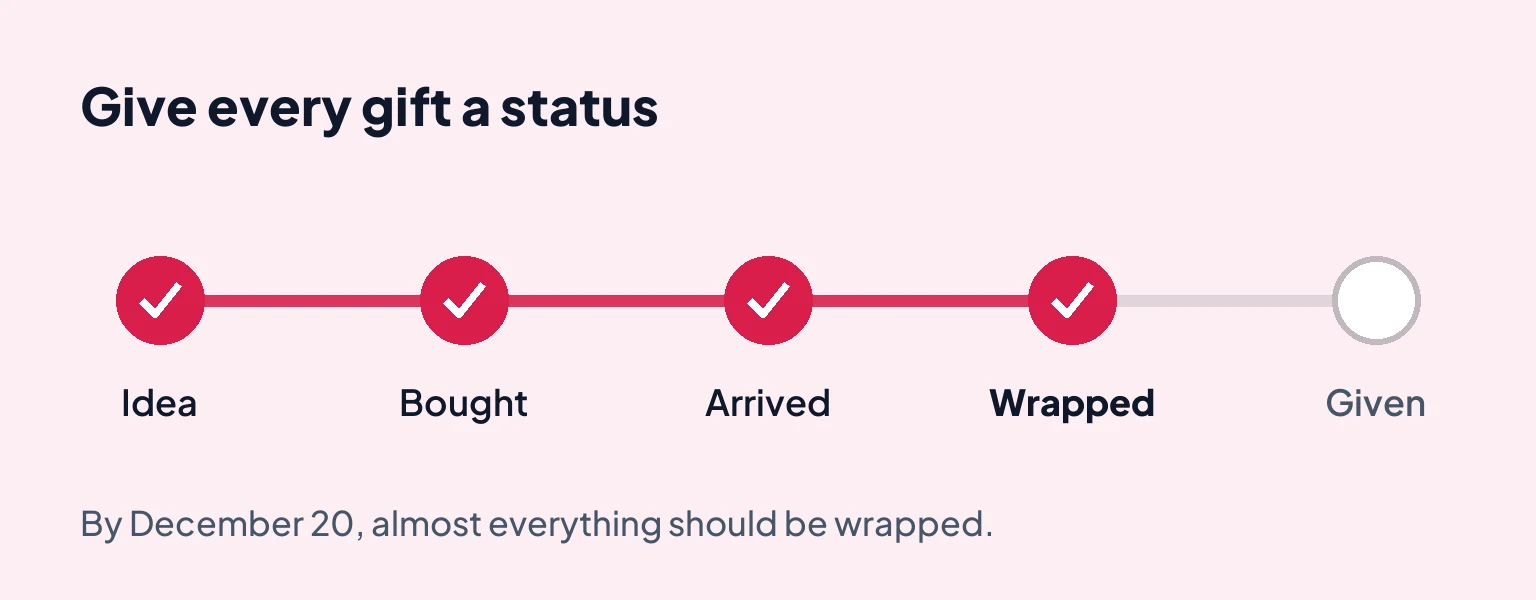
- Status: idea, bought, arrived, wrapped, given
The status column does most of the work. On December 20, you want to look at one screen and see that everything is wrapped except two gifts that haven't arrived.
The return-by date matters more than people think. If a store's window is 30 days and you buy a sweater on November 10, it's past the window by December 10, two weeks before anyone opens it. Check whether the store extends returns for the holidays and write down the real date. Keep the gift receipt with the item, or snap a photo of it.
Where to keep it
Honestly, it matters less than having only one list. A shared spreadsheet with a sum at the bottom of the price column works well for couples. A notes app works if you're the only one buying. A paper notebook is fine, as long as it doesn't leave the house.
What doesn't work is ideas split between your head and a text thread with your partner. That's how a kid ends up with two copies of the same LEGO set.
If you'd rather not build the spreadsheet, the gift tracker in Domus keeps people, a budget and each gift's status (from idea to delivered) in one place. It's part of Domus Plus, and it works best in a private circle that only you can see, so nobody opens the app and finds out what they're getting.
Hide it from the people on it
This is the one place a shared family app can backfire. If your list lives somewhere your 11-year-old can open, assume they will. Keep your gift list private, or at least separate from the family calendar and grocery list everyone else uses.
Ask for wish lists (and keep them spoiler-free)
The fastest way to stop guessing is to ask people what they want. For kids, a wish list also teaches them to choose, which helps when the list is 30 items long and the budget covers four.
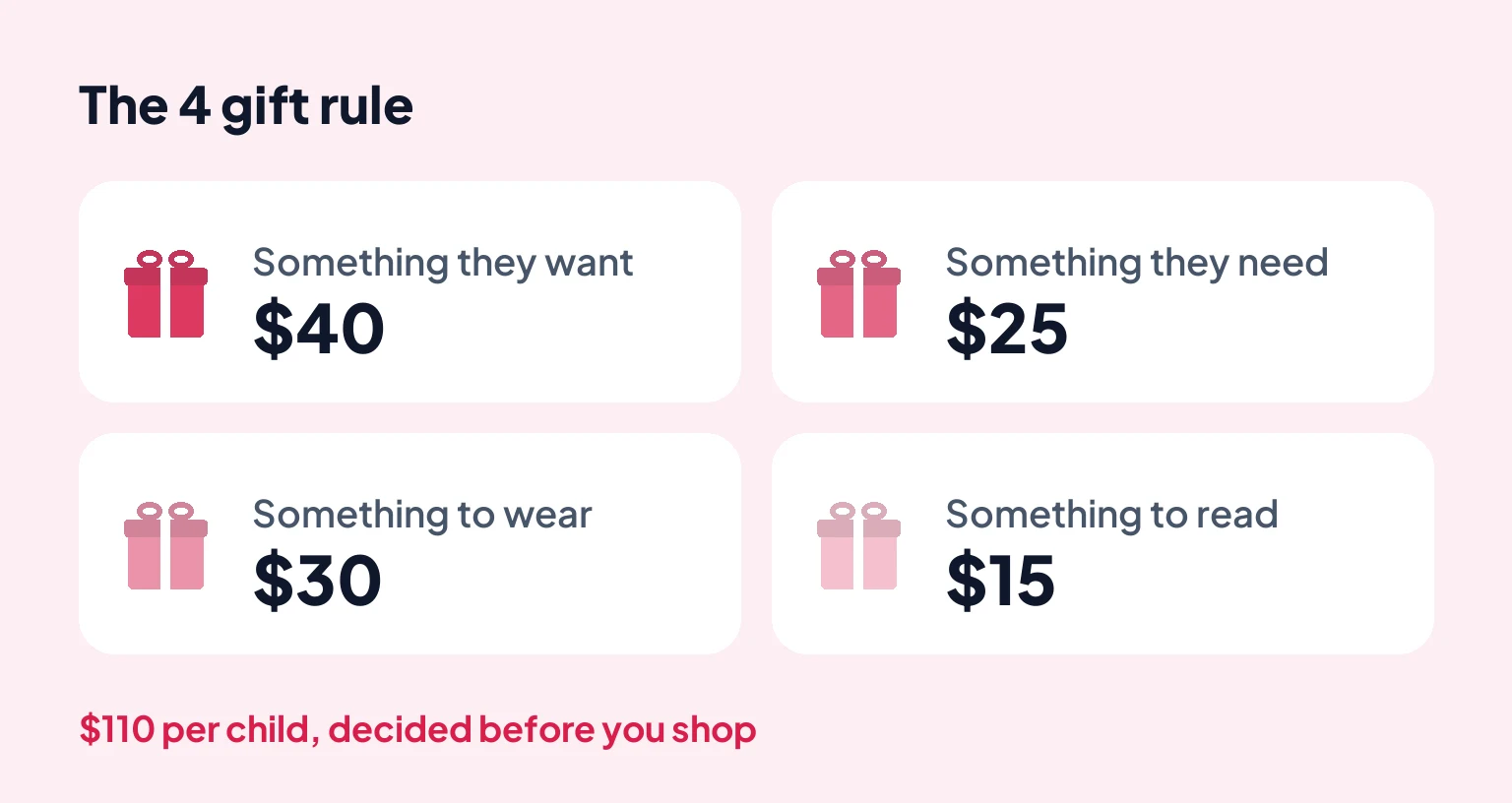
The 4 gift rule is a simple cap many parents use: something they want, something they need, something to wear, something to read. It keeps the number of presents under the tree predictable, and it's easy to budget. Want might be $40, need $25, wear $30, read $15.
For adults, wish lists cut down on returns. They work best when:
- Items have a link, a size and a color ("a hoodie" on its own isn't much help)
- There's a range of prices, so a $15 gift is as easy to choose as a $150 one
- Someone keeps track of what's been claimed, so two aunts don't buy the same thing
That last part is where most family wish lists break. A shared doc shows everyone what's been bought, including the person whose list it is. Wishlists in Domus are free: anyone in the circle can make one (kids too), and when someone claims an item, the owner never sees who did, so no spoilers. Other wish list apps do something similar. Whatever you use, the feature to look for is hidden claiming.

Coordinate with grandparents early
Grandparents often buy the big gift. If they don't know your plan, your kid gets two scooters. Share the wish list with them in early November and tell them which item is theirs. It's also the moment to mention anything you'd rather they didn't buy (another drum kit, say).
Plan for the costs that aren't on the list
Remember the 10 to 15 percent you held back? Here's where it goes. These are the costs that quietly push a Christmas gift budget over:
- Wrapping: paper, tape, tags, gift bags, ribbon
- Stocking stuffers: easy to spend $30–$50 per stocking without noticing
- Shipping: gifts you mail to family, plus any express upgrades in late December
- Cards and postage
- Thank-you gifts: teachers, daycare staff, coaches, the mail carrier, a babysitter
- Hosting and visiting: a bottle of wine or a dessert for every party you go to
- The last-minute name: the colleague who got you something, the neighbor who dropped off cookies
Some of these can move up to tier 4 if you know about them in advance. Teachers and coaches usually can. Put them on the list now with a number next to them.
A small stash helps with the last-minute names. Two or three $10–$15 gifts (good chocolate or a candle) bought in November mean nobody catches you empty-handed on December 23.
If you're also hosting Christmas dinner, keep the food budget separate; our holiday meal planning countdown covers that side.
When to buy what
A Christmas shopping list without dates turns into one long panic in mid-December. Spread it out:
| When | What to do |
|---|---|
| Early November | Set the total, build the tier list, ask for wish lists, suggest the name draw |
| Mid-November | Buy anything that might sell out (popular toys, a specific size) |
| Thanksgiving weekend to Cyber Monday | Buy tier 1 and 2 gifts you've already chosen and priced. Sales are only a deal if the item was on your list |
| First week of December | Order anything that ships. Buy tier 3 and 4 gifts |
| Mid-December | Mail packages. Wrap each gift the day it arrives |
| Week before Christmas | Pick up anything local and fill stockings from the stash |
If you're shipping within the US this year, USPS lists its recommended 2026 holiday send-by dates as December 17 for Ground Advantage, December 18 for Priority Mail and December 19 for Priority Mail Express, for addresses in the lower 48. USPS doesn't guarantee delivery by those dates, so give yourself a few days of margin. For anything going to or within Canada, Canada Post publishes its own holiday sending dates. Regular Parcel sent across the country (its National Zone) has to go out by December 10.
Check the list every week
Once a week, ideally the same evening, spend ten minutes on the list:
- Update the status of everything bought or delivered.
- Add up what you've spent against the total.
- Move money between tiers if one person's gift came in over or under.
- Look at what's still in "idea" and give it a deadline.
If you share the buying with a partner, do it together. That's when you'll catch a duplicate while you can still cancel the order.
By mid-December, the list should mostly say "wrapped".
If you also want the family calendar and chores in one place for the rest of the year, we've compared the options in our guide to the best family organizer apps.
And if you'd like the wish lists and the gift tracker on your phone this year, Domus wishlists are free, and the private gift tracker comes with Domus Plus.
Frequently asked questions
How much should I spend on Christmas gifts per person?
There's no standard amount. Decide your total first, then split it in tiers: most of it goes to your partner and kids, smaller fixed amounts to extended family, and a set figure for teachers, coaches and hosts. In the National Retail Federation's 2025 survey, Americans each planned to spend about $628 on gifts across their whole list, which is a useful sanity check for your total.
What is the 4 gift rule for Christmas?
It's a way to cap kids' gifts at four: something they want, something they need, something to wear and something to read. It gives each child a clear limit and makes the list easier to budget.
When should I start my Christmas shopping?
Write the list in early November and buy the big items before Thanksgiving weekend sales end. Anything you're mailing in the US should go out by mid-December; USPS recommends December 17 for Ground Advantage in the lower 48 for 2026.
How do I keep track of Christmas gifts I've already bought?
Give every gift a status (idea, bought, arrived, wrapped, given) and a price, and update it the moment you buy. A spreadsheet or a gift tracker app both work, as long as there's only one list.
How do I cut down my Christmas gift list?
Suggest a gift exchange like Secret Santa for adult siblings and cousins, give one gift per household instead of per person, and replace coworker gifts with a shared treat. Most people are relieved when someone else suggests it first.