Holiday meals
Holiday Meal Planning Without the Stress: A Countdown for Thanksgiving and Christmas

A turkey still frozen in the middle on Thursday morning. One oven and five dishes that all need it at 4 p.m. Three guests who each bring green beans, and a cousin who quietly eats nothing because nobody asked about her gluten allergy. Those are the things that sink a holiday dinner, and none of them is about the recipes. Holiday meal planning mostly means solving them in advance, and almost all of them can be solved on a calendar.
US Thanksgiving falls on November 26 this year, Christmas is a Friday, and New Year's Eve is the following Thursday. If you're in Canada, your Thanksgiving was back on October 12, so skip ahead to Christmas. The approach is the same for all three meals.
Start with the headcount and the oven
Before you pick a single recipe, answer two questions: how many people are eating, and what does your kitchen physically allow?
The headcount sets the quantities, and the kitchen limits the menu. One standard oven holds a turkey and almost nothing else for three to four hours. If your menu has a roast, stuffing, sweet potato casserole, rolls and two pies that all want 350°F or more on the same afternoon, it doesn't work, no matter how good the recipes are.
So take an honest inventory:
- How many oven racks, and how many burners?
- Do you have a slow cooker, an Instant Pot, an air fryer or a toaster oven that can take one dish off the oven's plate?
- How much fridge space can you free up the week before?
- How many serving dishes, chairs and plates do you actually own?
Then plan the menu to fit. A good rule is that only the main and one side should need the oven in the last two hours. Everything else is either made ahead, cooked on the stove, kept warm in a slow cooker, or served cold.
How much food to plan for
Quantities are where holiday meals get expensive. Some rules of thumb that hold up:
| Item | Per adult | For 10 adults |
|---|---|---|
| Whole turkey (bone-in) | 1 to 1.5 lb | 10 to 15 lb |
| Mashed potatoes | about 1/2 lb raw potatoes | 5 lb |
| Stuffing | about 3/4 cup | 2 quarts |
| Gravy | about 1/3 cup | about 3.5 cups |
| Rolls | 1 to 2 | 2 dozen |
| Pie | 1 slice (8 slices per pie) | 2 pies, 3 if you want leftovers |
Count kids under 10 as half. If your family treats leftovers as the real point of the holiday, push the turkey to 1.5 pounds per person.
Your holiday meal planning countdown
Here's the Thanksgiving timeline worked out for Thursday, November 26. For Christmas dinner on the 25th, shift every line by four weeks and a day.
| When | What to do |
|---|---|
| 3 weeks out (by Nov 5) | Confirm the guest list. Ask everyone about allergies and diets. Decide the menu around your oven. Order a fresh turkey or buy a frozen one |
| 2 weeks out (Nov 12) | Hand out dishes to guests. Write the full shopping list and split it into "keeps" and "fresh". Count plates, chairs and serving dishes |
| 10 days out (Nov 16) | First shop: drinks, canned goods, flour, butter, broth, foil, containers for leftovers. Make and freeze pie dough |
| Weekend before (Nov 21–22) | Clean out the fridge. Move a frozen turkey into the fridge to thaw: Saturday for 18 to 20 lb, Sunday for 16 lb or less (see below). Make gravy base and freeze it |
| Monday–Tuesday (Nov 23–24) | Second shop for fresh produce, dairy and bread. Make cranberry sauce. Chop onions, celery and carrots and store them in containers |
| Wednesday (Nov 25) | Bake pies. Assemble casseroles and refrigerate them unbaked. Make mashed potatoes. Set the table. Write a timed plan for tomorrow, working back from dinner |
| Thursday morning | Turkey in the oven. Casseroles out of the fridge an hour before baking |
| Last hour | Turkey rests. Casseroles and stuffing go into the free oven. Reheat potatoes and gravy. Warm the rolls last |
If you're reading this in mid-November, you're on the "10 days out" row, and that's fine. Send the allergy question and hand out dishes today, then carry on down the table.
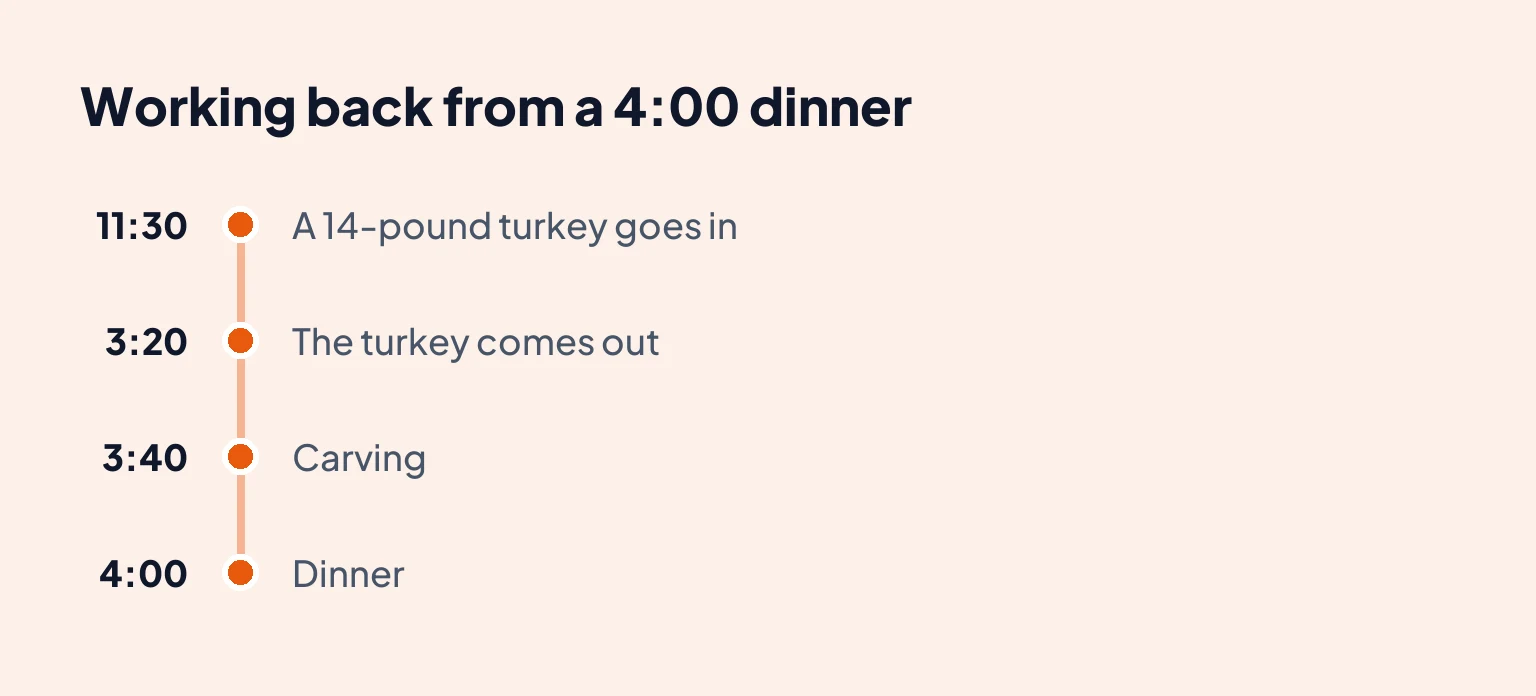
The Wednesday "timed plan" sounds fussy, and it's the part people skip. Write it backward from the time you want to eat: dinner at 4:00 means carving at 3:40, which means the turkey comes out at 3:20, which means a 14-pound bird goes in by about 11:30. Put every dish on that list with a time next to it, and tape it to a cabinet door.
Thawing the turkey (start earlier than you think)
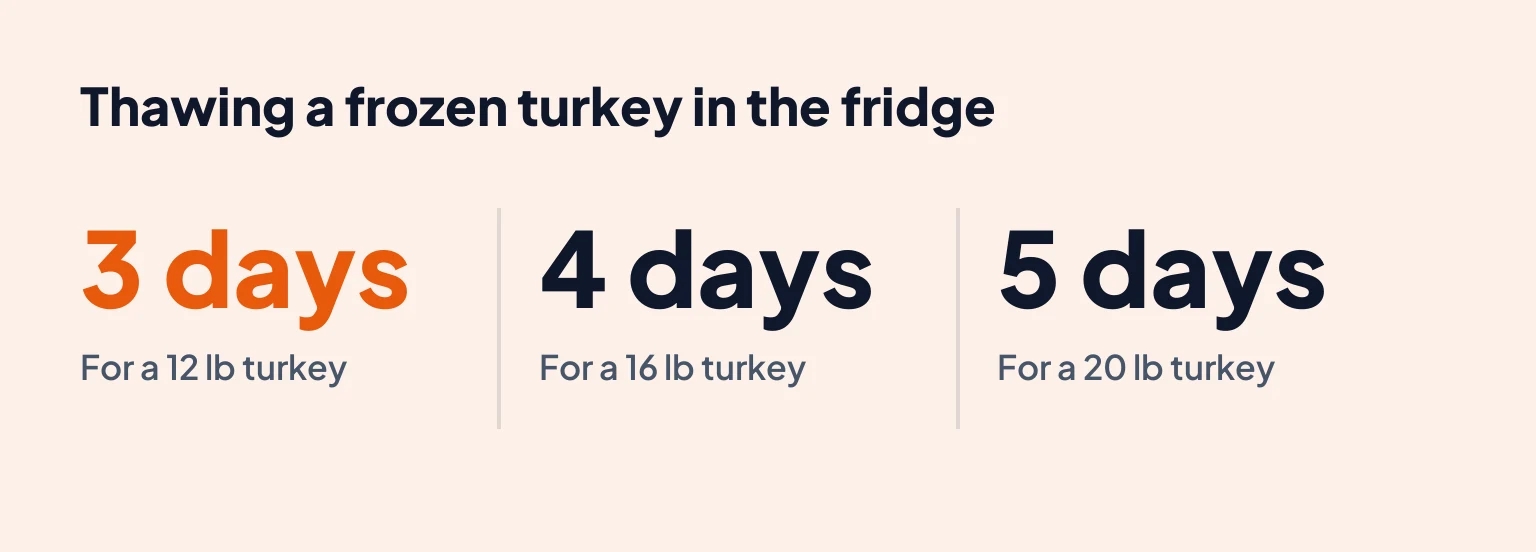
This is the one step you can't fix on the day. According to the USDA's Food Safety and Inspection Service, a frozen turkey needs about 24 hours in the refrigerator for every 4 to 5 pounds, with the fridge at 40°F or below. That works out to:
- 12 lb: about 3 days
- 16 lb: about 4 days
- 20 lb: about 5 days
Once it's thawed, a turkey keeps in the fridge for another day or two, so starting early is safer than cutting it close. If you're behind, the cold-water method takes about 30 minutes per pound: keep the bird in its leak-proof wrapping, submerge it in cold tap water and change the water every 30 minutes. A turkey thawed this way has to be cooked right away. Never thaw it on the counter.
Cook it to 165°F in the thickest part of the thigh, the wing and the breast, measured with a food thermometer. FSIS also recommends letting it stand about 20 minutes before carving, and that rest is your window to get the sides into the oven.
What to make ahead (and what to leave for the day)
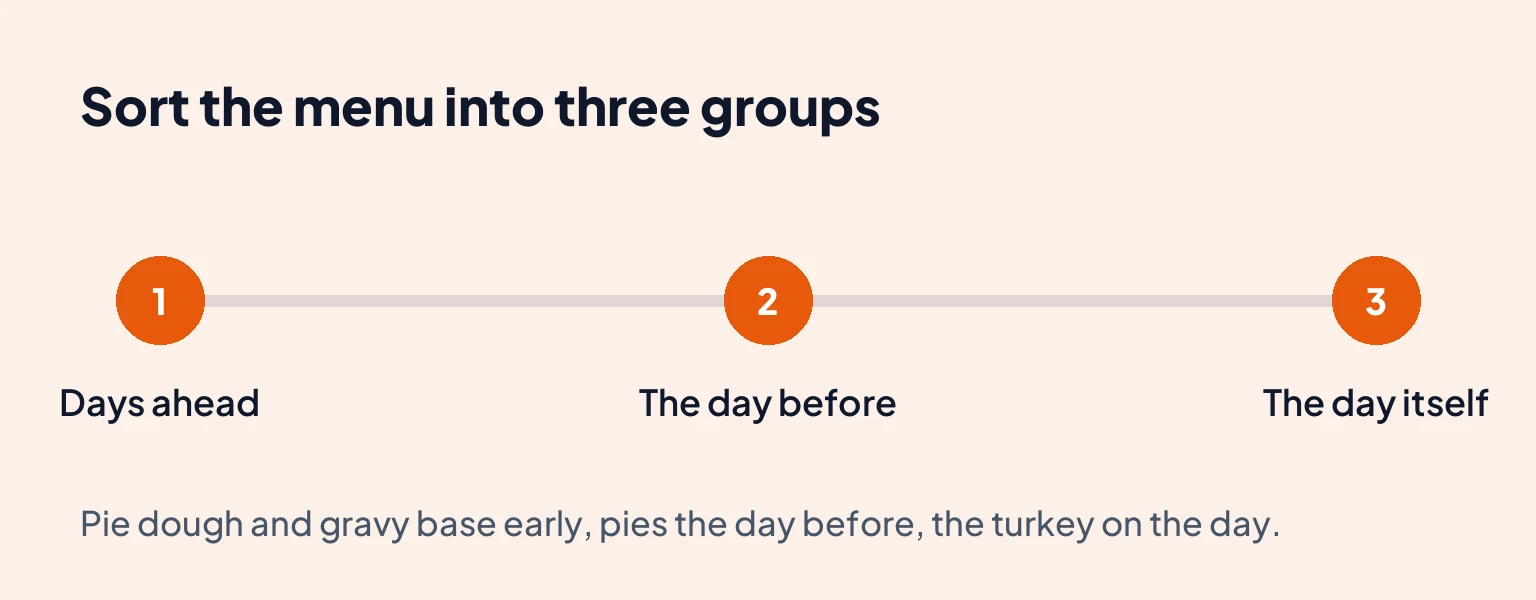
Make-ahead is the difference between cooking dinner and running a restaurant for one afternoon. Sort the menu into three groups.
Days ahead. Pie dough (freeze it in discs), cranberry sauce, gravy base made from roasted turkey wings or necks, salad dressing, chopped aromatics, toasted bread cubes for stuffing, and cookie dough if you do a dessert tray.
The day before. Pies (pumpkin and other custard pies go in the fridge once they're cool), mashed potatoes, unbaked casseroles like green bean or sweet potato, and stuffing assembled in its baking dish. Don't stuff the turkey the night before; if you cook stuffing inside the bird, mix it right before it goes in, and it also has to reach 165°F.
The day itself. The turkey or roast, anything that's meant to be crispy, the rolls, and any green salad dressed at the last minute.
Mashed potatoes are the best make-ahead trade in the whole meal. Make them Wednesday with a little extra butter or cream, then reheat them in a slow cooker on low for two to three hours on Thursday. They stay hot and free up a burner for the gravy.
Gravy is the other one. Most of the last-hour panic is gravy. If you've made a base from roasted wings and stock days earlier, you just reheat it and whisk in the drippings from the pan.
Hand out dishes to guests (and be specific about it)
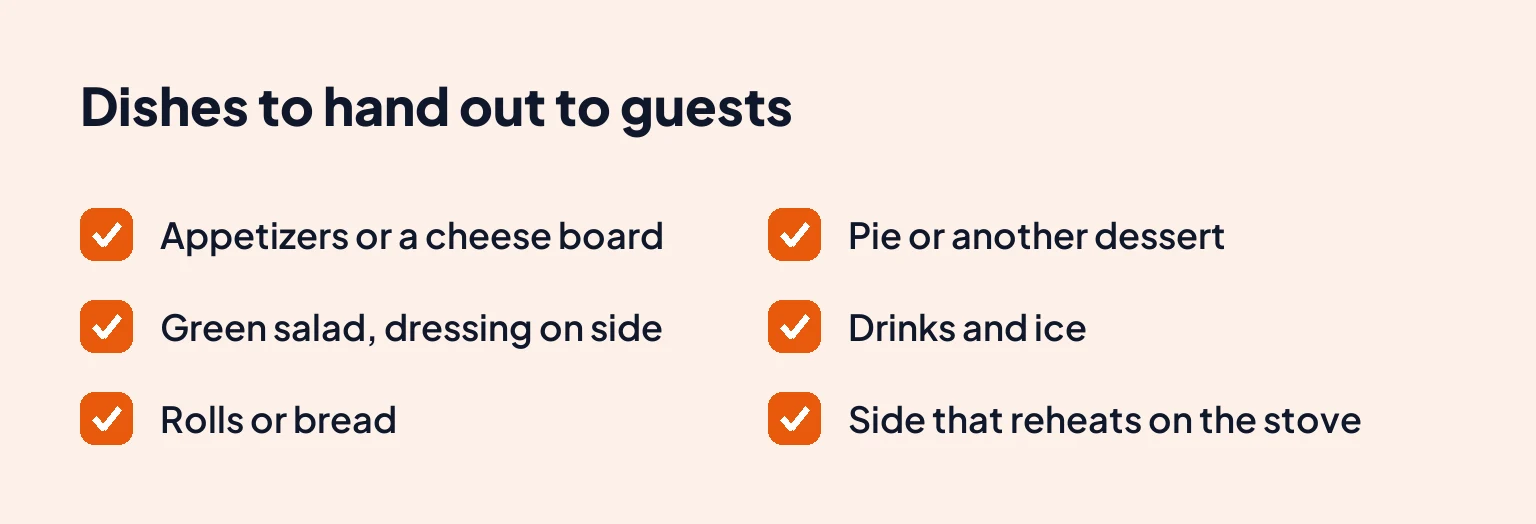
"Just bring something" is how you end up with three bags of rolls and no vegetables. When someone offers to help, give them a specific dish, and assign the ones that make sense to travel:
- Appetizers or a cheese board that can sit out for an hour
- A green salad, with the dressing in a jar on the side
- Rolls or bread
- Pie or another dessert
- Drinks and ice
- A side that reheats on the stove or doesn't need heating at all
Avoid giving guests anything that has to go into your oven at the last minute, since the turkey has it until the rest.
Ask them to bring it ready to serve, in its own dish, with its own serving spoon. That's a small request that saves you washing six extra pieces of cookware at 10 p.m.
Keep the list in one place that everyone can see: who's bringing what, and how many it serves. A group text loses track of it within a day, especially once somebody's sister-in-law says "I'll bring something sweet" and nobody remembers what she meant. A shared list works better. In Domus you can share a list with a guest link, so relatives who don't use the app can open it in a browser and add their name next to a dish without making an account.
Kids can take real jobs too. A 6-year-old can set out napkins and put rolls in a basket. A 10-year-old can make place cards, fill water glasses and run the timer list. Teens can peel potatoes on Wednesday and own the dishwasher after dinner.
Plan for allergies and dietary needs early
Ask about diets when you send the invitation, three weeks out, not the night before. The usual list covers vegetarian or vegan, gluten-free, dairy-free, nut allergies and anyone managing diabetes or a low-sodium diet.
The goal is that every guest can make a full plate from what's on the table, which rarely takes a separate menu. Some practical ways to get there:
- Make one side substantial enough to work as a vegetarian main, like a stuffed squash or a mushroom and lentil casserole that bakes at the same temperature as the turkey.
- Thicken the gravy with cornstarch instead of flour, and it's gluten-free for everyone.
- Keep nuts as a topping in a bowl rather than baked into the sweet potatoes.
- Make the stuffing with vegetable broth and cook it in a dish. Vegetarians can eat it, and it's safer to cook.
Label the dishes on the table with a sticky note or a folded card ("contains nuts", "gluten-free", "vegetarian"). If someone has a serious allergy, give their safe dishes their own serving spoons and put them out first, before anything can get mixed up at the buffet.
If you plan meals for the whole year and not just the holidays, Domus can show allergy warnings on planned meals using the allergies saved in Family Health. It's part of Domus Plus. A note on the fridge does the same job for one evening.
Christmas and New Year's: run the same plan again
Christmas dinner usually comes four weeks after Thanksgiving, often for a different mix of people, and a lot of families cook twice that week: Christmas Eve and Christmas Day. Treat them as one plan, so the Eve meal can share ingredients and prep with the big one.
A few things that help:
- Make Christmas Eve simpler on purpose. A big pot of soup or chili, a lasagna you assembled on the 22nd, or a ham that only needs reheating. The cook needs one meal that mostly cooks itself.
- Reuse the Thanksgiving notes. If you wrote down which dishes ran out and which came back barely touched, adjust the Christmas quantities before you shop.
- Do the same thaw math for a Christmas turkey. A 16-pound bird for Friday the 25th goes into the fridge on Sunday the 20th or Monday the 21st.
- For a roast beef or ham, buy by weight per person again (about 1/2 lb boneless or 3/4 to 1 lb bone-in per adult) and let the meat rest while the sides finish.
New Year's Eve usually works better as a grazing table than as a sit-down dinner. Pick dishes that can sit out briefly or come out in rounds: a slow-cooker meatball dish, a baked dip, a cheese and charcuterie board, shrimp cocktail kept on ice. In the South, plenty of families put black-eyed peas and greens on the table on New Year's Day, which makes a cheap, make-ahead pot for the morning after.
If you want the everyday version of this kind of planning for January onward, our guide to family meal planning for beginners covers a weekly routine. And since December dinners and December gifts tend to fight over the same budget, it's worth reading how to organize your Christmas gift list at the same time.
Leftovers: plan them before dinner
Leftovers are the best part of the holiday for a lot of families, and the part most likely to go to waste. The clock starts when the food comes off the table.
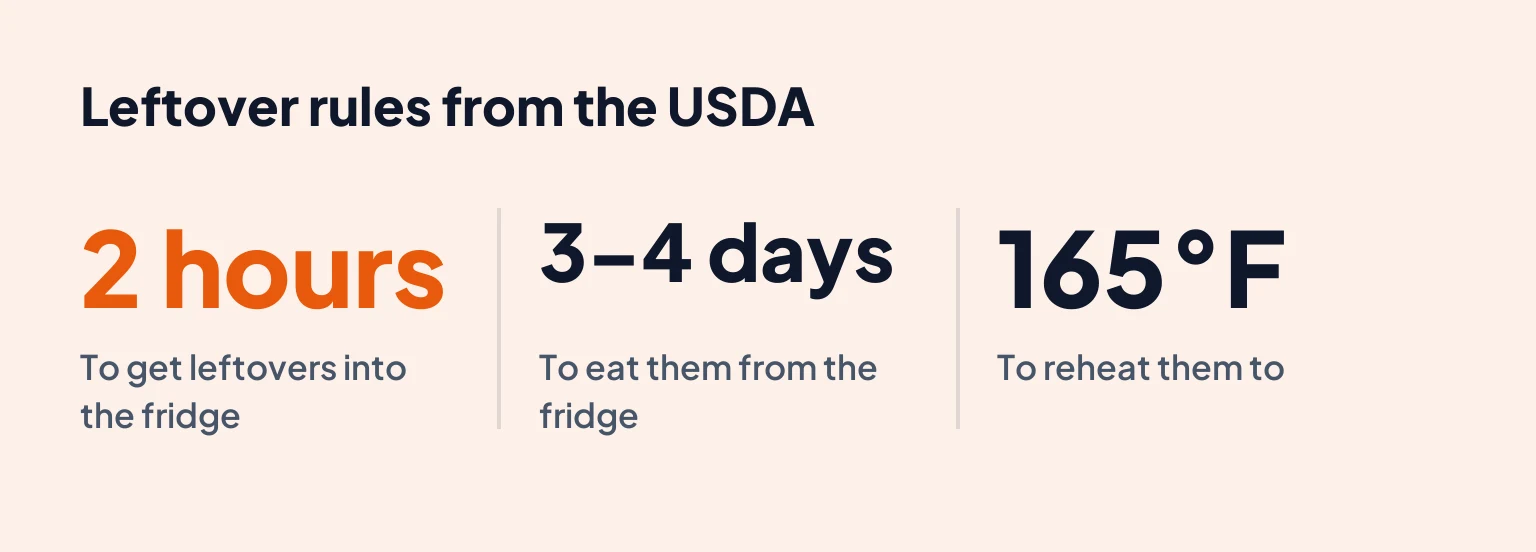
The USDA's guidance on leftovers and food safety is short:
- Refrigerate leftovers within 2 hours of cooking. Food left out longer than that should be thrown away.
- Divide big amounts into shallow containers so they cool quickly. Carve the turkey off the bone first.
- Eat refrigerated leftovers within 3 to 4 days.
- Freeze anything you won't get to by then. Frozen leftovers stay safe, though quality is best within a few months.
- Reheat leftovers to 165°F.
For Thanksgiving dinner on Thursday, that means the last turkey sandwich is Monday. Whatever's still in the fridge by Monday night goes in the freezer or the trash.
Put "turkey soup" on Saturday's dinner slot and "turkey and cranberry sandwiches" on Friday lunch, and buy the bread and broth in the second shop. Have containers ready before dinner so guests can take a plate home, which is the easiest way to clear the fridge before day 3. Freeze the carcass in a bag and make stock from it whenever you have an afternoon; it's a good base for the soups in our list of cheap family meals.
On Monday, write down what you over-bought while you still remember. That note is the first draft of your Christmas shopping list.
If you're looking for a family app to hold the meal plan and the shared shopping list, we compared the main options in our guide to the best family organizer apps.
If you'd like this year's holiday menu and shopping list in one place, Domus is free to start: plan the week's meals and turn their ingredients into a grocery list the whole family shares.
Frequently asked questions
How far in advance should you plan a holiday meal?
Start about three weeks out. That's enough time to lock the guest list, ask about allergies, order or buy a frozen turkey, and split the shopping into two or three smaller trips instead of one huge one the day before.
How long does it take to thaw a turkey?
In the refrigerator, the USDA says to allow about 24 hours for every 4 to 5 pounds, so a 20-pound bird needs four to five days. In cold water it's about 30 minutes per pound, changing the water every 30 minutes, and the turkey has to be cooked right after.
How much turkey do I need per person?
The usual rule of thumb is about 1 to 1.5 pounds of whole turkey per guest, since much of the weight is bone. Go to the higher end if you want leftovers.
What can I make ahead for Thanksgiving dinner?
Pie dough, cranberry sauce, gravy base and chopped vegetables can be done days ahead, and mashed potatoes and most casseroles can be made a day or two early and reheated. Keep the day itself for the turkey and anything that has to be crisp.
How long are holiday leftovers good for?
The USDA says to refrigerate leftovers within two hours and eat them within 3 to 4 days. If you won't get to them by then, freeze them in portions.