Groceries
How to Make a Grocery List That Actually Cuts Your Food Bill

Most grocery lists get finished in the store. Someone remembered milk, someone else texted that the kids are out of cereal, and everything else gets decided in the aisles, which is exactly where the money leaks out. Learning how to make a grocery list properly takes about 20 minutes a week, and it changes what lands in the cart more than any coupon will.
Order matters. A list that starts with "what do we need?" fills up with cravings, so the first thing to write down is nothing at all. Go look in the fridge.
Start with what's already in the kitchen
Before you write a single item, open the fridge. Then the freezer, then the pantry. You're looking for food that needs eating in the next few days, and for anything you're about to buy a second jar of.
Five minutes is plenty. Check:
- the produce drawer (half a bag of spinach, two soft peppers, a lemon)
- open containers: yogurt, sour cream, pasta sauce, deli meat
- the freezer, where forgotten chicken thighs go to wait
- pantry basics you're never sure about, like rice, oil, flour and canned tomatoes
Jot the "use soon" items at the top of a scrap of paper. They'll turn into meals in the next step.
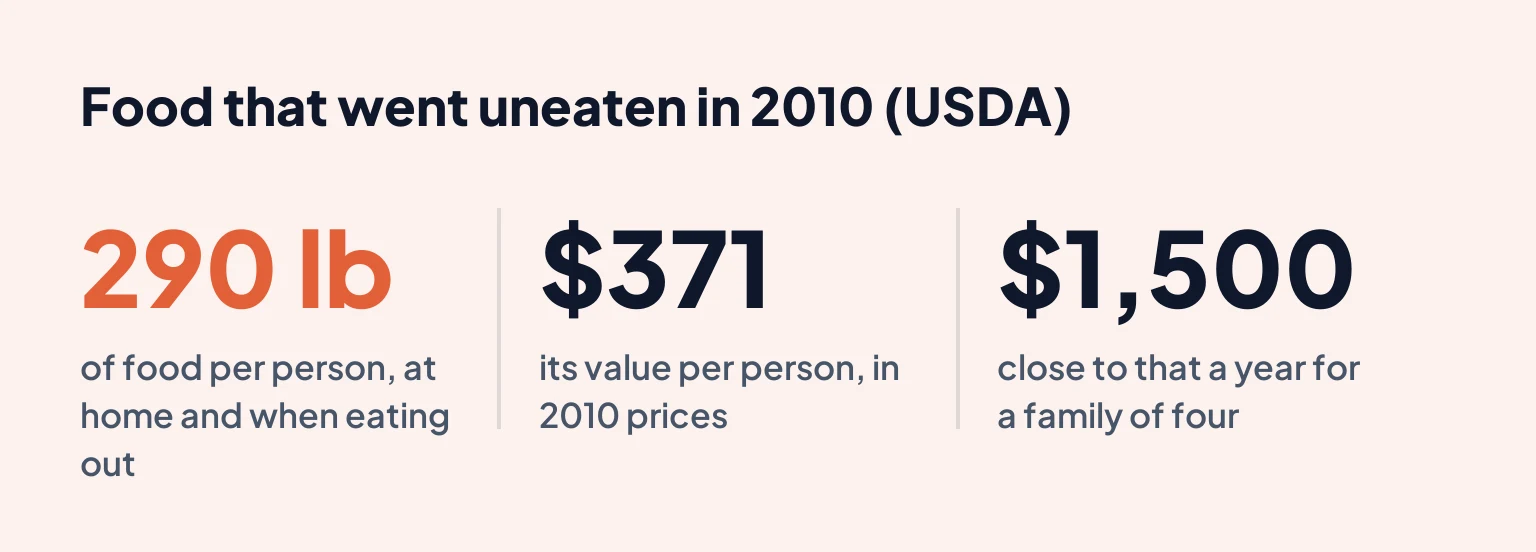
This is the step that cuts waste. USDA's Economic Research Service estimated that at the consumer level, which counts food left uneaten at home and when eating out, about 290 pounds of food per person went uneaten in 2010, worth $371 at the time. For a family of four, that's close to $1,500 a year, in 2010 prices. The share that happens at home is the share a list can do something about.
Plan the meals, then write the list
The list should come out of the meal plan. Pick the week's dinners first; breakfasts and lunches tend to repeat, so they can live on the staples list.
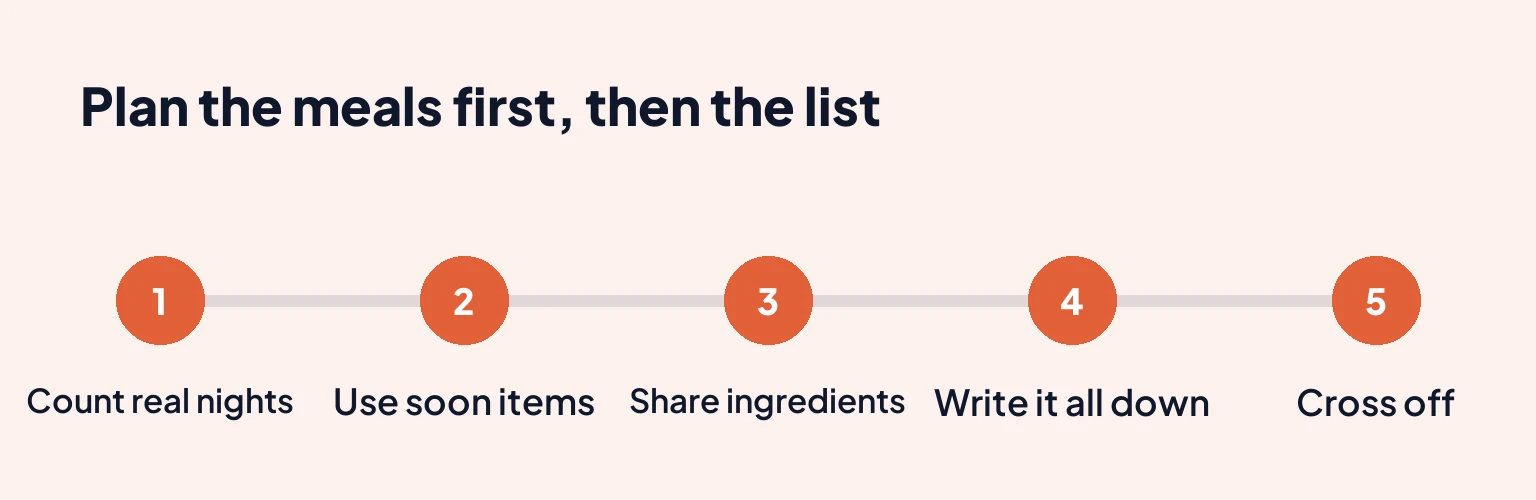
Count the nights you'll really cook
Say you're a family of four with soccer practice on Tuesday and a birthday party on Saturday. That week has room for maybe five home-cooked dinners, plus a leftovers night and an eggs-on-toast night. Plan for the week you'll actually have, because the chicken for a dinner that never happens still has to be eaten by Friday.
Use up the "use soon" items first
Go back to your fridge notes. The soft peppers and half an onion become fajitas on Monday. The spinach goes into Tuesday's pasta. Only after that do you add new meals.
Pick meals that share ingredients
A bunch of cilantro bought for one recipe usually dies in the drawer. Used in tacos on Monday and a rice bowl on Thursday, it's gone by Friday. The same goes for a family pack of chicken thighs: roast half on Sunday and stir-fry the rest on Wednesday. A bigger pack only saves money if the whole pack gets eaten.
As you go through each recipe, write down every ingredient, then cross off what you already have. Whatever's left is your list. Our family meal planning guide goes deeper on the planning itself, and if you want meals that keep the cost per plate low, start with our cheap family dinners.
Know what a week of groceries should cost
A list without a number has no brakes. You need a target before you shop.
The USDA publishes monthly food plans that price a nutritious diet cooked entirely at home, at four cost levels. In the September 2026 report, this is what each plan costs for a couple with two kids aged 6–8 and 9–11:
| USDA food plan | Per week | Per month |
|---|---|---|
| Thrifty | $236.30 | $1,024 |
| Low-cost | $260.10 | $1,127 |
| Moderate-cost | $320.50 | $1,389 |
| Liberal | $388.00 | $1,682 |
These are national averages for a four-person household. USDA suggests adding 10% for a two-person household and 5% for three, and your local prices will move the number too.
Use it as a reality check. If you're spending $400 a week for that family and still ordering takeout twice, the list is the first place to look. The gap between the Moderate and Thrifty plans is about $84 a week, and a lot of it comes down to choices your list makes before you're in the store: the cut of meat, the brand, fresh berries or frozen.
If you've never worked out what you can spend on food each month, our free family budget planner gives you that number in a few minutes.
How to make a grocery list that follows the store
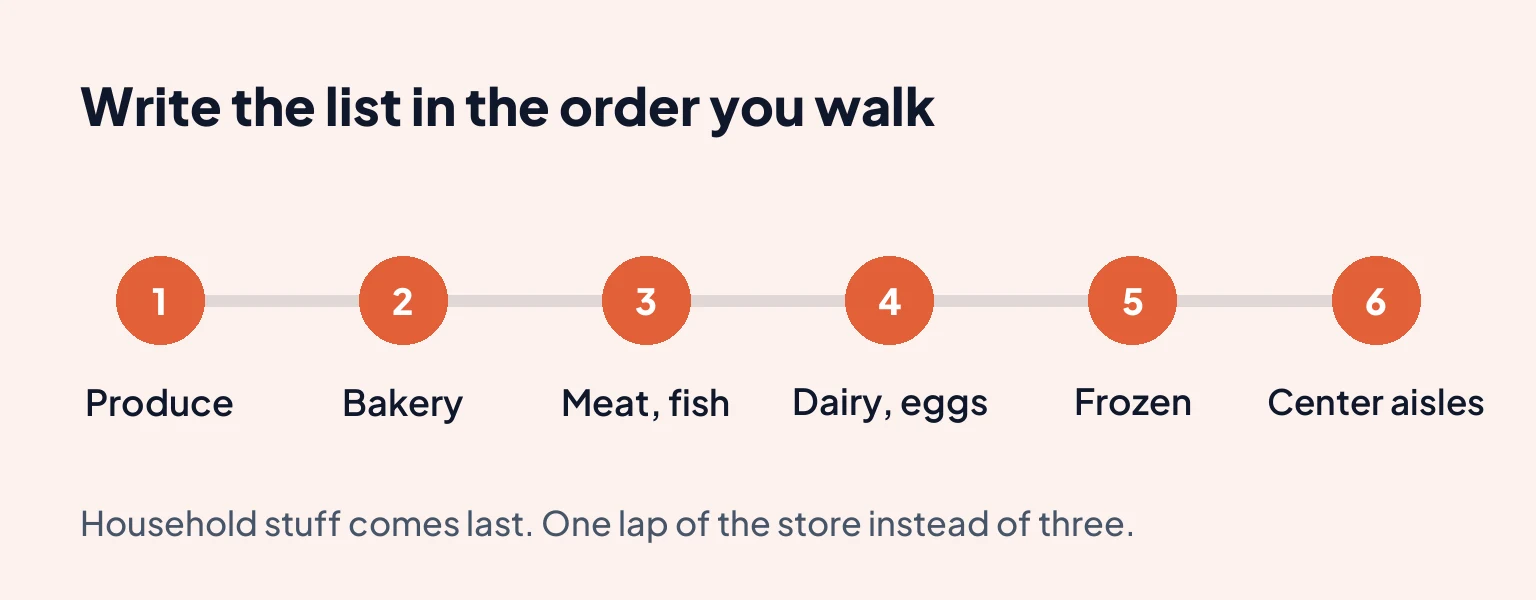
Now sort it. Group items by section, in the order you'll walk past them: produce, bakery, meat and fish, dairy and eggs, frozen, the center aisles, then household stuff.
A list in store order means one lap instead of three. That matters for more than time. Every extra trip down an aisle is another pass by the end-cap displays, and doubling back to aisle 3 for the canned beans you missed is how a $5 bag of chips joins them.
If you shop at the same store every week, match its real layout. Walk it once with the list, write the aisle numbers next to each section, and reuse that order every week after.
Write quantities and specifics
"Chicken" isn't a list item. "2 lb boneless chicken thighs" is. Quantities stop you from grabbing the family pack out of habit, and specifics matter even more when someone else does the shopping: "bread" can come home as a $6 bakery loaf when you meant the $2.50 sandwich bread.
Add a note when there's a fallback. "Broccoli (or green beans, whichever is cheaper)" lets whoever's shopping make the smart swap without calling home.
Keep a staples list on the side
Staples are the things you always keep in the house: milk, eggs, bread, rice, pasta, onions, oil, coffee, toilet paper. They don't need weekly planning. Keep them on a running list and add each one when it runs low, before the last one is gone.
A typical grocery staples list for a family looks something like this:
| Section | Staples |
|---|---|
| Produce | onions, garlic, carrots, bananas, apples |
| Dairy and eggs | milk, eggs, butter, shredded cheese, plain yogurt |
| Pantry | rice, pasta, oats, canned tomatoes, canned beans, peanut butter, flour, oil |
| Frozen | peas, broccoli, berries |
| Household | dish soap, trash bags, paper towels |
The house rule that makes it work: whoever uses the last of something adds it to the list. That includes kids old enough to type or write, and the teenager who finishes the cereal at 11 p.m.
Price anchors and unit prices
Keep a short price book
A price book only needs the 15 or 20 things you buy most often. Write down what you normally pay for each one and the lowest price you've seen.
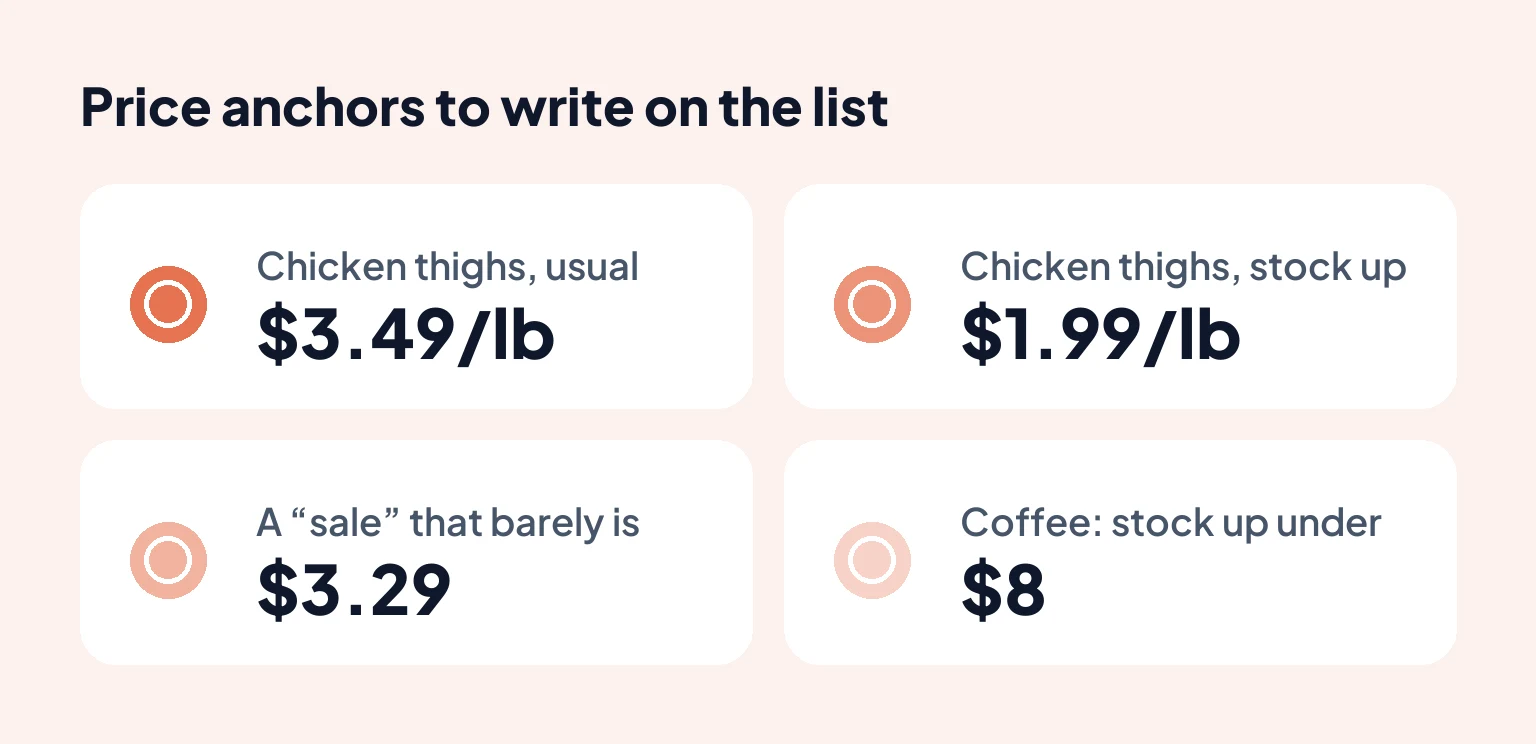
Say chicken thighs usually cost you $3.49 a pound. When they're $1.99, you buy two packs and freeze one. When the tag says "SALE $3.29", you'll know it barely is one. Some chains only give the sale price to loyalty members, so keep the store cards on your phone (we compared the best loyalty card apps).
You can put anchors right on the list: "coffee (stock up under $8)", "butter (buy 3 if under $3)". It turns the list into a buying guide for whoever's holding it.
Compare the unit price
The unit price is the small number on the shelf tag: cost per ounce, per pound or per count. It's the only fair way to compare a 24-ounce jar with a 32-ounce one, or a 6-pack with a 12-pack.
Bigger is usually cheaper per ounce, but sales on smaller sizes and "2 for $5" deals flip it often enough that it's worth a two-second look. Check the store brand next to the name brand too. It's very often the lower unit price for the same product.
Bulk has a catch. A 10-pound bag of potatoes at a great unit price is a bad deal if 3 pounds sprout. Buy bulk for things that keep, like rice, canned goods, frozen vegetables and toilet paper, and buy fresh food in the amounts your meal plan calls for.
One list for the whole household
A household with more than one list buys things twice, or three times. Dad picks up ketchup on the way home from work, Mom already grabbed a bottle on Saturday, and the 16-year-old who drove to the store for pizza night bought a third. Do that with a few items a week and it adds up, plus a fridge door full of duplicate condiments.
The fix is boring and it works. There's one list, everyone adds to it, and whoever shops checks items off in the store. A paper list on the fridge is fine if one person always does the shopping. Once two or three people shop, the list has to live on everyone's phone and update live, so when one person buys milk, everyone else sees it crossed off before they stop at the store. For couples setting this up, our guide to a shared grocery list for couples walks through it step by step.
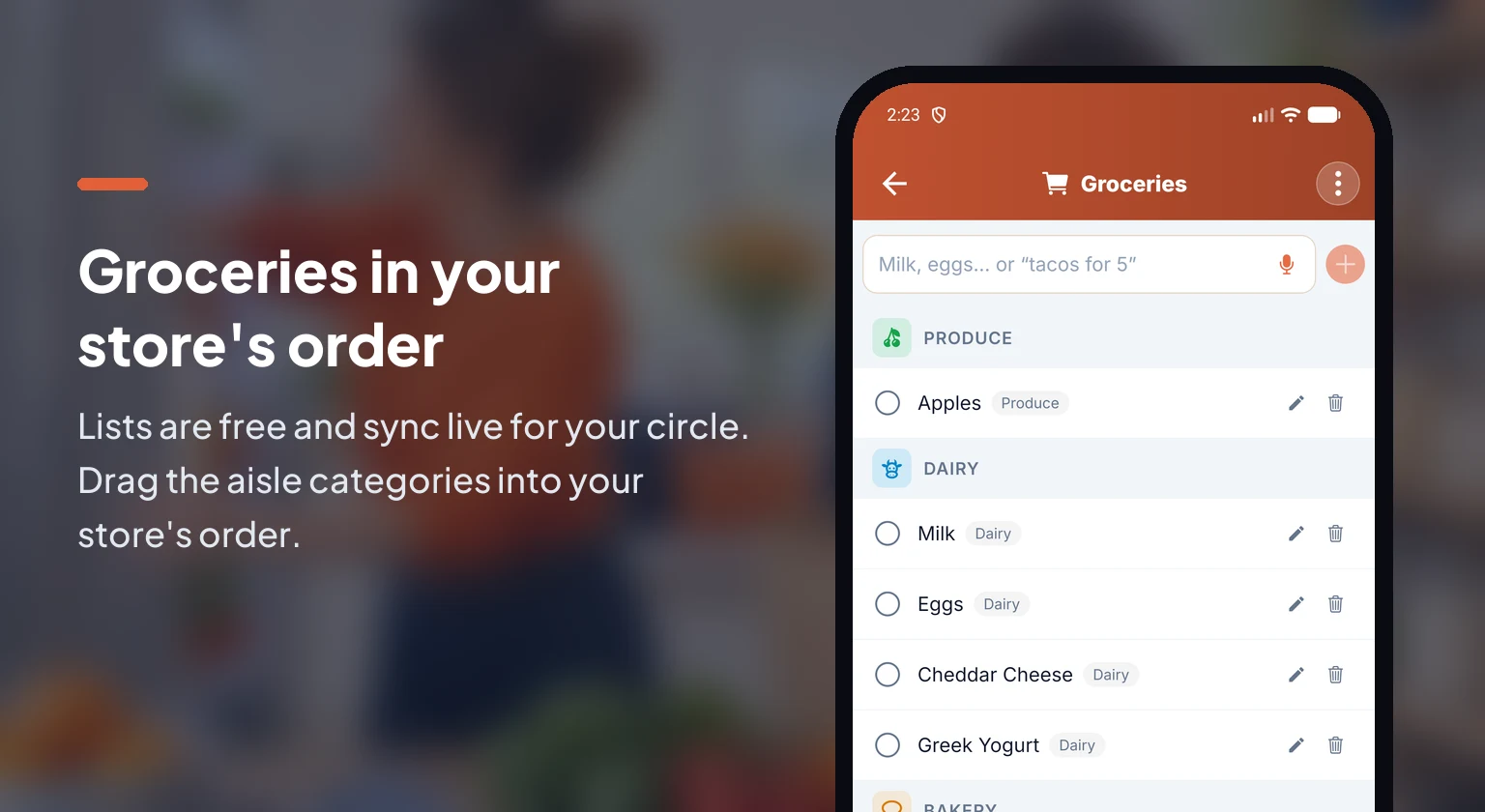
In Domus, lists are free and sync live for everyone in your circle. Grocery items are sorted into aisle categories that you can drag into your own store's order, and you can turn the week's meal plan into a grocery list. Plenty of other apps handle shared lists well too, and we compare them in our roundup of the best grocery list apps.
At the store, let the list decide
The list only saves money if it wins the arguments in the store. A few rules help:
- Eat before you go. Shopping hungry makes everything look like dinner.
- Shop in list order and check items off as you go.
- If it isn't on the list, it goes on next week's list instead of in the cart. The exception is a staple at or below its anchor price.
- Swap within the plan. If broccoli is $3.99 and green beans are $1.79, the stir-fry won't mind.
- If the kids come along, give each of them one section of the list to fetch.
When you get home, take two minutes before the bags are unpacked. Note anything the store was out of so it carries over to next week's list, and update any anchor price that changed.
A sample weekly grocery list
Here's what the finished list might look like for a family of four planning five dinners (fajitas, spinach pasta, roast chicken, chicken stir-fry, bean chili), with staples added and the fridge already checked:
| Section | Items |
|---|---|
| Produce | 3 bell peppers, 1 bag onions, 1 head garlic, 2 lb broccoli (or green beans), 1 bunch cilantro, bananas, 6 apples |
| Bakery | 1 sandwich loaf, 8 flour tortillas |
| Meat | 4 lb chicken thighs (family pack under $2.50/lb) |
| Dairy | 1 gallon milk, 18 eggs, shredded cheese |
| Frozen | peas, berries |
| Pantry | 2 cans black beans, 2 cans crushed tomatoes, 1 lb pasta, rice (only if under $1/lb) |
| Household | dish soap |
If the grocery list is only one of the things your family keeps in five different places, we've compared the apps that bring the calendar, chores and lists together in our guide to the best family organizer apps.
And if you'd like this week's list on everyone's phone, sorted in your store's aisle order, lists in Domus are free.
Frequently asked questions
What should be on a basic grocery list?
Two parts: the ingredients for the meals you've planned this week, and the staples that ran low, like milk, eggs, bread, rice, onions and coffee. Anything that fits neither part is an impulse buy and can wait a week.
How do I organize a grocery list by aisle?
Group items by store section in the order you walk the store, usually produce, bakery, meat, dairy, frozen, then the center aisles and household goods. If you always use the same store, note its aisle numbers once and reuse that order every week.
How much should a family of 4 spend on groceries a week?
As a benchmark, USDA's September 2026 food plans price a nutritious home-cooked diet for two adults and two school-age kids at about $236 a week on the Thrifty plan and about $321 on the Moderate-cost plan. Your area and diet will move that number, so treat it as a sanity check.
How do I make a weekly grocery list on a budget?
Check the fridge and pantry first, plan dinners around what needs using up, write quantities for every item, and compare unit prices on anything you buy often. Set a weekly total before you shop so the list has a limit.
Is a paper grocery list or an app better?
Paper works fine when one person does all the shopping. Once two or more people shop, a shared app that updates live is better, because everyone sees what's already been bought.