Chores
Age-Appropriate Chores: The Complete List of Chores for Kids by Age

A 4-year-old can't empty the dishwasher, and a 12-year-old who has never done a load of laundry is closer to leaving home than most parents realize. Somewhere between those two kids sits a sensible list of chores for kids by age, and it's longer than you'd think. Kids can handle more than we usually ask of them, as long as the job is matched to their size and attention span, and to how much supervision you can give.
Treat the age bands as a guide. A careful 6-year-old might fold towels better than a distracted 9-year-old, so start from what your kid can actually do.
Chores for kids by age: the quick list
If you only read one thing, read this table. The lists line up with the age guidance published by the American Academy of Pediatrics on HealthyChildren.org and the American Academy of Child and Adolescent Psychiatry.
| Age | Typical chores | How much help | Time per day |
|---|---|---|---|
| 2–3 | Toys in the bin, clothes in the hamper, napkins on the table | Right beside them, every time | 5–10 min |
| 4–5 | Feed the pet, make the bed (roughly), clear their own plate, match socks | You start it, they finish | 10–15 min |
| 6–7 | Set and clear the table, put laundry away, sweep, wipe counters, empty small trash cans | Check at the end | 15–20 min |
| 8–9 | Load and unload the dishwasher, vacuum a room, put groceries away, simple snacks, walk the dog | Check now and then | 20–30 min |
| 10–12 | Run a load of laundry, clean the bathroom, change sheets, cook a simple meal with supervision | Teach once, spot-check | 30 min |
| 13+ | Cook a full dinner, grocery shop from a list, mow the lawn, babysit, clean the car | Owns it | 30–45 min |
Each band keeps the chores from the bands before it. A 10-year-old still makes their bed.
Ages 2–3: helping, mostly
At this age, a “chore” is really helping you while you do the job. Toddlers like to copy, and that's worth more than the result. The AACAP's list for 2- and 3-year-olds is short: putting toys and groceries away, and getting dressed with help.
Good jobs for this age:
- Putting toys back in one big bin (not sorted into five)
- Dropping dirty clothes into the hamper
- Carrying napkins or plastic cups to the table
- Putting unbreakable groceries, like cereal boxes and apples, on a low shelf
- Wiping a spill with a cloth you hand them
- Giving the dog its food when you've already measured it
Keep each job to a couple of minutes and do it with them. A specific request, like “let's put all the cars in the basket”, gets a 3-year-old moving far faster than “go clean your room”, which is too big for them to picture.
Ages 4–5: the first real jobs
Preschoolers can own a small job from start to finish, as long as it has few steps and the same steps every day. AACAP says 4- and 5-year-olds can help feed pets, make their beds (“maybe not perfectly”) and help clear the table after dinner.
- Making their bed (pulling up the comforter counts)
- Carrying their own plate to the counter after meals
- Feeding the pet, with the food pre-measured in a cup
- Matching socks from the clean laundry
- Watering plants with a small watering can
- Putting shoes and coats where they belong
- Helping unload the dishwasher: they hand you the cutlery
Plan for lumpy beds and wet floors. Redoing the job in front of them teaches them their version doesn't count, so fix things later or let them go.
Ages 6–7: the table, the laundry, the floor
This is the age when chores start to actually help you. The AAP's list for 5- to 7-year-olds is surprisingly long. It includes making the bed, setting and clearing the table, making and packing school lunches, sweeping floors, sorting laundry and emptying wastebaskets.
- Setting the table for dinner and clearing it afterward
- Putting their own folded laundry in drawers
- Sorting a laundry pile into lights and darks
- Sweeping the kitchen with a small broom and dustpan
- Wiping the table and counters (a spray bottle of water and a cloth is plenty)
- Emptying the bathroom and bedroom trash cans
- Packing their own school lunch from options you've set out
- Bringing in the mail
Lunch-packing is underrated. Put out a few fruits, two sandwich options and a snack shelf, and let them build it the night before. Most first-graders can manage it in about five minutes once they've done it a few times.
Ages 8–9: chores for 8 year olds and up
Around 8, kids can follow a sequence of steps without you standing there. That opens up the bigger jobs. The AAP's 8–10 list adds vacuuming, helping with dinner, making their own snacks, walking the dog, and putting away laundry and groceries. AACAP puts loading and unloading the dishwasher at 7 to 9.
- Unloading the dishwasher (everything except the sharp knives)
- Loading it after dinner
- Vacuuming one room
- Putting away the groceries
- Making their own breakfast or after-school snack
- Walking the dog around the block (with you for the first few weeks)
- Folding towels and their own clothes
- Raking leaves or pulling weeds
Our free chore chart for 8 year olds has a list ready to print if you'd rather not build one from scratch.
Honestly, this is also the age when paper charts start to struggle. An 8-year-old with soccer twice a week and a sibling with a different schedule needs chores that change by day, and a fridge chart gets messy fast.
Ages 10–12: laundry, bathrooms, a simple meal
By 10, a kid can learn almost any household job if you teach it properly once. The AAP's list for 11- and 12-year-olds includes cleaning the kitchen, changing bedsheets, doing and folding laundry, scrubbing toilets and cleaning the bathroom, washing the car, and cooking a simple meal with supervision.
- Running a full load of laundry: sort, wash, dry, fold
- Cleaning the bathroom sink, mirror and toilet
- Changing their own sheets
- Cleaning up the kitchen after dinner
- Cooking something simple, like pasta or scrambled eggs, with you nearby
- Taking the trash and recycling to the curb on pickup day
- Washing the car
This is the band where cleaning products come in. Show them which ones to use where, and keep anything with bleach for later. Laundry is the big one. Once a 12-year-old can run their own load, their soccer uniform can be clean for Saturday without you being involved, and you can hand over towels and sheets next.
Ages 13 and up: teens can run the house
Teenagers can do every chore an adult does. The question is mostly time, since school, sports and part-time jobs pile up. Give them fewer jobs that are bigger and that they fully own, and stop telling them how to do each one.
- Cooking dinner for the family once a week, including planning it
- Grocery shopping from a list
- Mowing the lawn
- Deep-cleaning the kitchen or bathroom
- Babysitting younger siblings
- Cleaning the inside of the car
- Managing their own laundry from start to finish
For mowing, the AAP's lawn mower safety advice is that kids should be at least 12 to use a walk-behind power mower and 16 to use a riding mower.
Teens also respond better to owning an area than to a list of tasks. “The kitchen after dinner is yours on Tuesdays and Thursdays” lands better than six separate reminders. If you need a starting point, our teenage chore chart has a ready-made list.
How to introduce a new chore
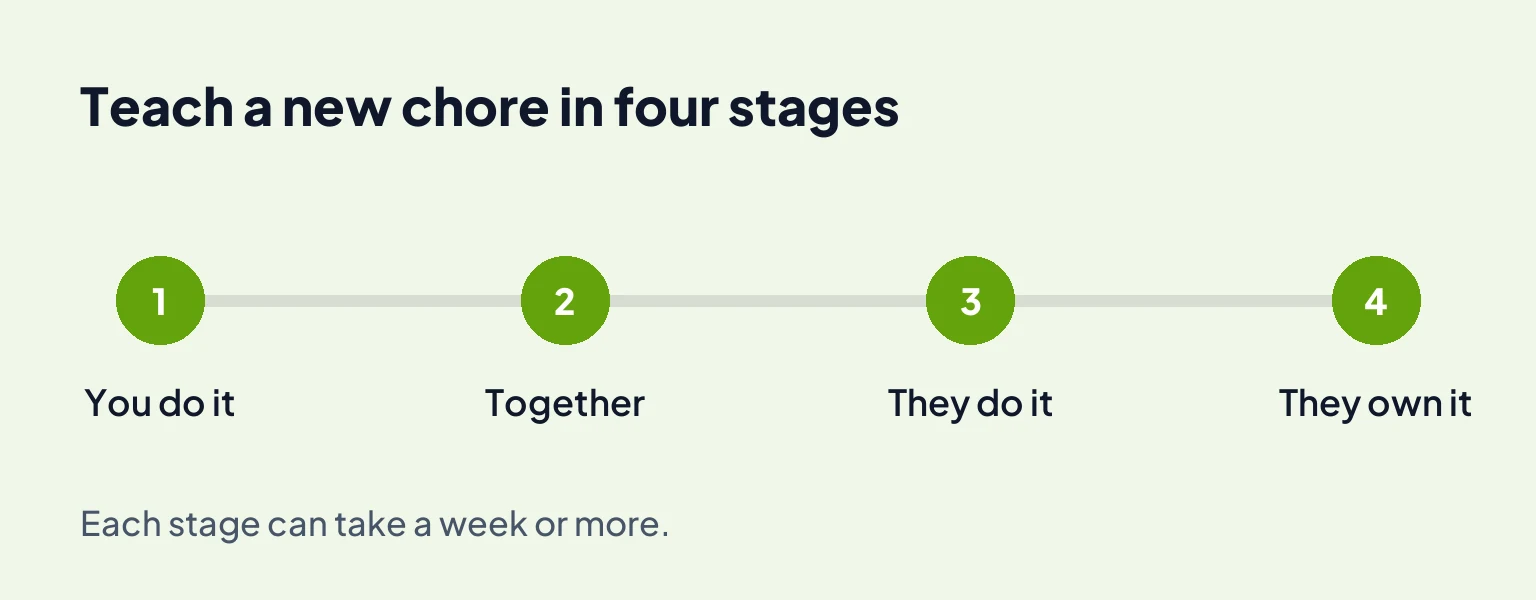
A lot of the frustration with chores comes from handing over a job before the child has seen it done. It works better to teach it in four stages, and each one can take a week or more:
- You do it, they watch. Talk through the steps out loud: “Plates go on the bottom, cups on top, spoons point up.”
- You do it together. They do the parts they can, you do the rest.
- They do it, you watch. Bite your tongue. Fix only what really matters.
- They own it. You check at the end, sometimes.
Break bigger jobs into steps they can see. For a 9-year-old, “clean the bathroom” becomes “spray the sink, wipe the sink, wipe the mirror, put the towel on the hook”. For non-readers, a picture card for each step works.
Then attach the chore to something that already happens every day: the table after dinner, the bed before breakfast, the backpack before screen time. The AAP's advice is the same, to build chores into a routine and do them at the same time each day.
How many chores, and when
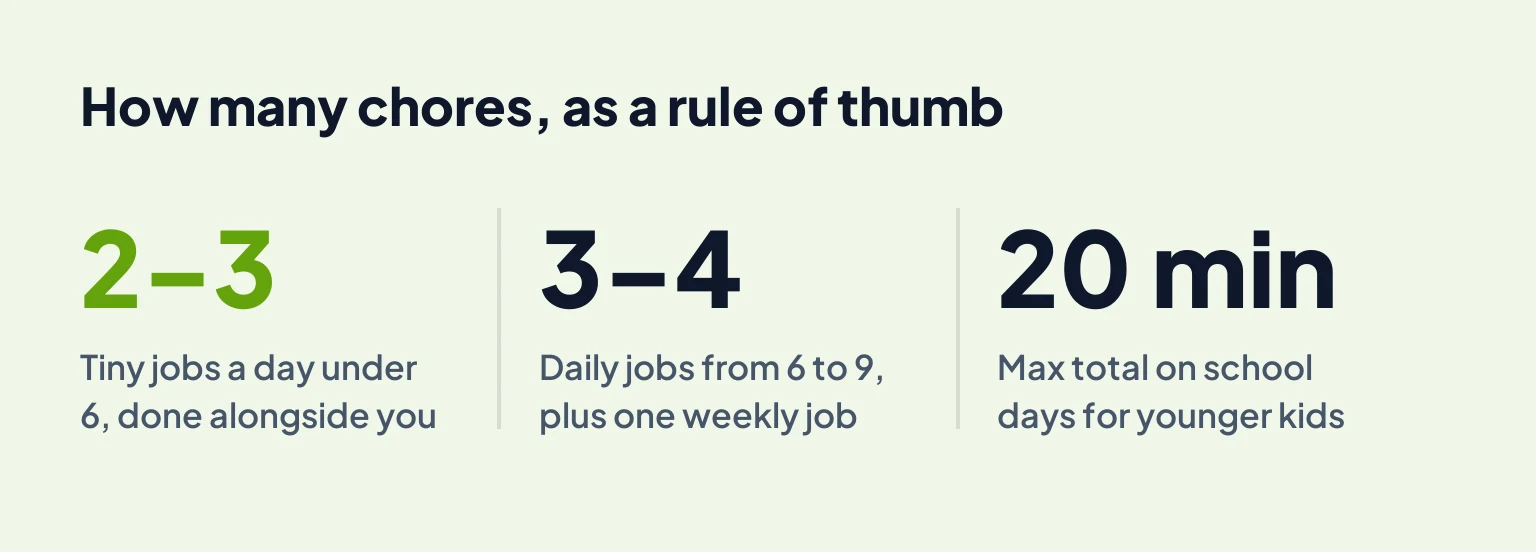
As a rule of thumb, kids under 6 can handle two or three tiny jobs a day, all done alongside you. From 6 to 9, three or four daily jobs plus one weekly job (vacuuming their room, say) is plenty. From 10 up, keep a few daily jobs and add one bigger weekly job they choose from a list.
On school days, keep the total under 20 minutes for younger kids. Weekends can carry the bigger jobs.
If you're splitting the work between two adults as well, it helps to sort that out first. We wrote a separate guide on splitting household chores fairly as a couple.
Should kids get paid for chores?
Parents disagree on this one, and there's no single right answer.
The case for paying
- Kids learn that money is earned, and they get real practice managing it.
- It gives you a lever that doesn't involve yelling. A chore that isn't done means no money, and the consequence is clear.
- It mirrors adult life, where work and pay are linked.
The case against
- Everyday jobs like clearing your plate are part of living in a home. Paying for them suggests they're optional.
- A kid who doesn't need money right now can simply opt out. A 13-year-old with birthday cash will happily skip a week of dishes.
- Some kids start negotiating: “How much if I take out the trash?”
The middle ground most families land on
Plenty of families split chores into two groups. Family jobs (bed, table, own laundry, pet) are unpaid, because everyone who lives here helps. Extra jobs (washing the car, raking the whole yard, cleaning out the garage) are paid, at a price agreed up front.
If you give a regular allowance on top, keep it separate from the family jobs. That way it teaches budgeting, and you don't end up withholding it every time a bed doesn't get made.
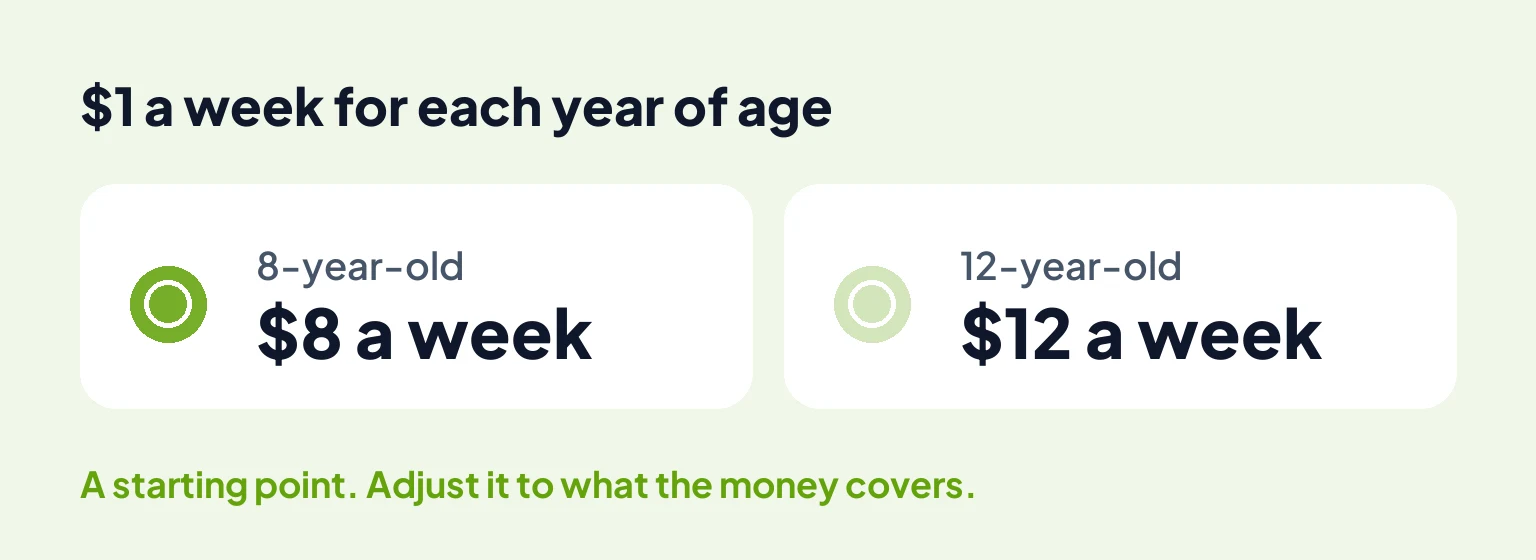
As for how much: a common rule of thumb is $1 a week for each year of age, so $8 for an 8-year-old and $12 for a 12-year-old. Treat that as a starting point and adjust it to what the money is expected to cover.
Keeping kids motivated (without nagging every day)
Motivation fades. Every family hits the week where the 9-year-old “forgot” to feed the cat three days in a row. A few things help.
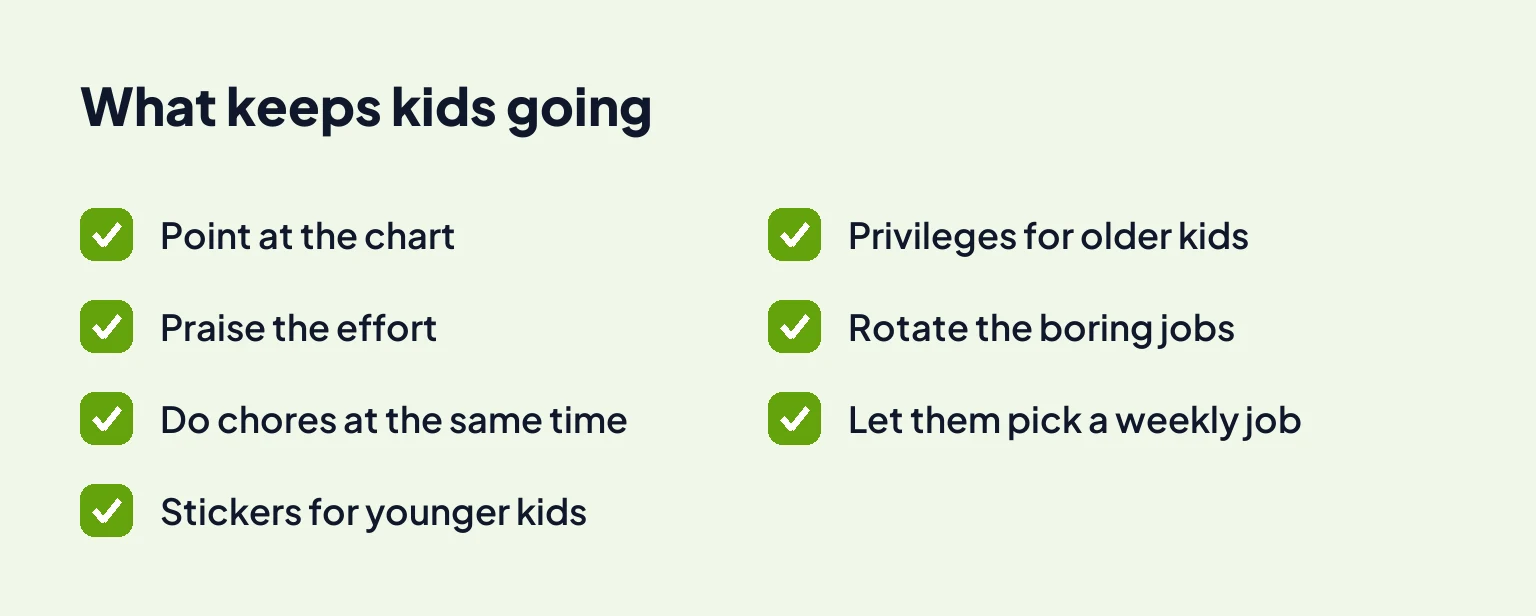
A chart on the fridge or a list on a tablet means you can point at it instead of repeating yourself, and kids under 9 like ticking things off.
Praise the effort. The AAP suggests praising effort over outcome and keeping it honest: “You remembered the trash without me asking” lands better than “Great job!” on a half-done task.
Doing chores at the same time as your kids helps a lot. A 15-minute family tidy before dinner, with music on, feels very different from being sent off alone.
For younger kids, stickers or points tied to finished chores are a reasonable tool, and the AAP mentions them too. Older kids usually care more about privileges, like an extra half hour of screen time on Friday.
Two smaller things: rotate the boring jobs every week or two so nobody is on toilets forever, and once a week offer a few bigger jobs and let each kid pick one. People are more willing to do the job they chose.
Our free chore chart maker builds a printable chart by age if you want something on the fridge today. For a 5-year-old, start with the chore chart for 5 year olds, which uses short, picture-friendly jobs.
When a paper chart stops working
Paper works well until you have two or three kids on different schedules, chores that repeat on different days, and a parent who's at work when the chart needs checking. At that point, an app that everyone can see keeps it simpler.
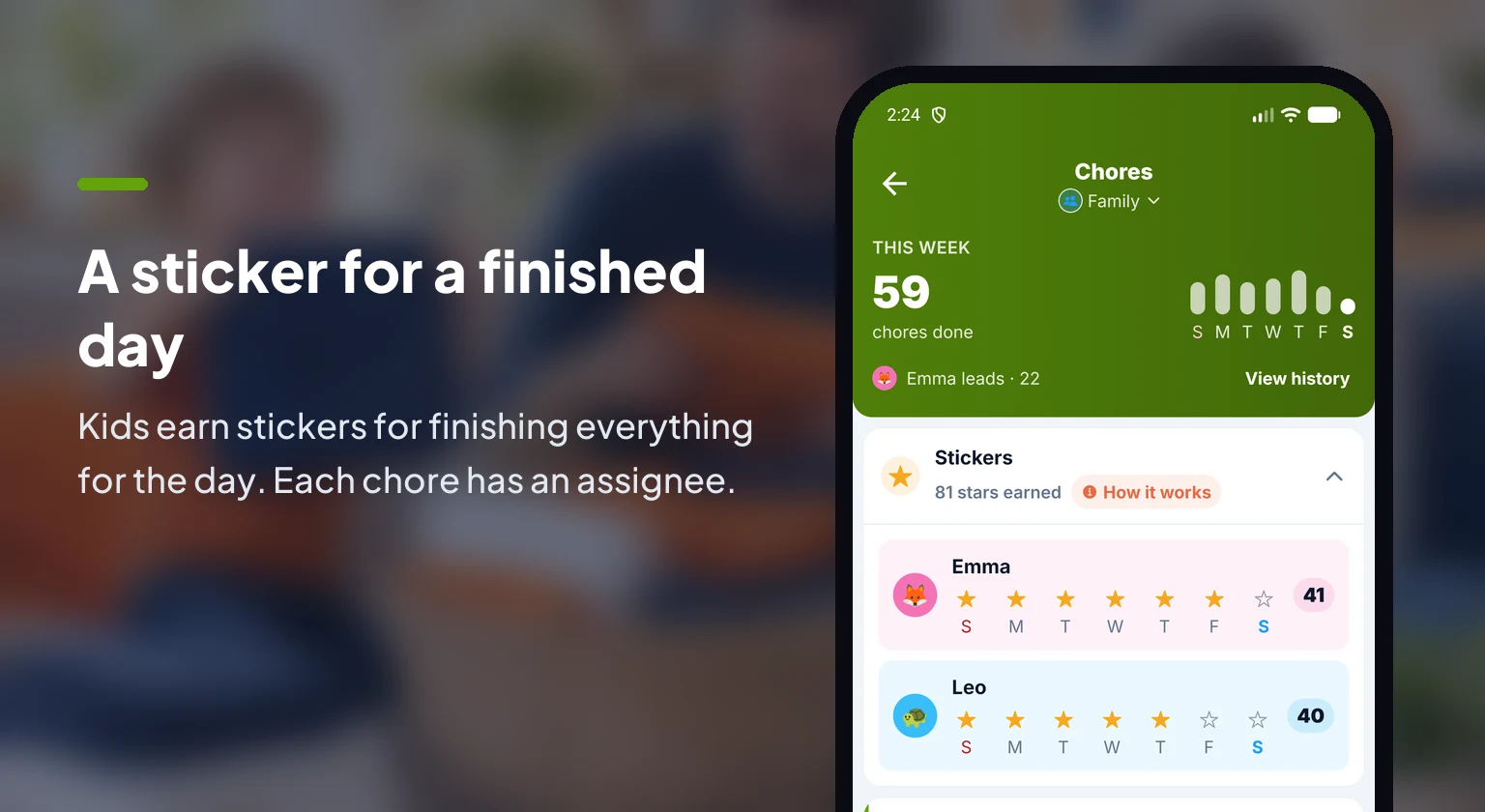
In Domus, chores have an assignee and a part of the day (morning, afternoon or evening), and kids earn stickers for finishing everything for the day. With Domus Plus, chores can repeat automatically, and kids mode locks the phone to the kids' chore board so you can hand it to a child. We compared other options in our roundup of chore apps for kids.
If you're also juggling a family calendar, meals and the grocery list, we looked at how the main apps handle all of it in our guide to the best family organizer apps.
And if you'd like the chore list on everyone's phone instead of the fridge, Domus is free to start, chores included.
Frequently asked questions
What chores can a 3-year-old do?
Short, one-step jobs done next to you: putting toys in a bin, dropping dirty clothes in the hamper, carrying napkins to the table, putting unbreakable groceries away. Expect help, not finished work, and keep each job under five minutes.
What chores should a 7-year-old do?
Making their bed, setting and clearing the table, putting their own laundry away, feeding a pet, wiping the table and sweeping a small floor. The American Academy of Pediatrics also lists packing a school lunch and emptying wastebaskets for the 5–7 range.
How much should I pay my kids for chores?
There's no standard amount. A common rule of thumb is about $1 a week per year of age, so $8 for an 8-year-old. Many families keep everyday chores unpaid and pay only for extra jobs, like washing the car.
How many chores should a child have?
Two or three tiny daily jobs for kids under 6, three or four from 6 to 9 plus one weekly job, and for older kids a few daily jobs plus one bigger weekly job. Time matters more than the count: roughly 10 minutes a day for preschoolers, up to 30 or 45 for teens.
At what age should kids start doing chores?
Around age 2, when most toddlers want to copy what you're doing. At that age it's about the habit of helping, so it's fine if the job takes longer than doing it yourself.